 7:54 AM
 monica
This is part of my Urban Wildlife Watch:Travelog Europe Series where I introduce wildlife and botanicals I came across while traveling to Europe August 18-31, 2009.
Pollinators are animals that visit flowers and distribute pollen among individual flowers. Most pollinators are invertebrate species like bees, wasps, flies, and butterflies and vertebrate species like hummingbirds. These animals visit flowers for their nutritious, high-calorie nectar. Sometimes they also dine on the pollen.
While consuming from the attractive (visually and olfactory) flowers, the animals get dusted with pollen - the white or yellow dust on the anthers of the flower. When the animal visits another flower and repeats the behavior, pollen from a previous flower gets left behind and the cycle repeats itself.
The old saying "It's all about the birds and the bees" is about this very activity - pollination. The saying is also used to refer to sex. That's because pollen is actually the sperm cells, or male gametes, of a flower. In fact, flowers are the reproductive parts of plants. Next time you step to smell a flower, take a closer look. A complete flower has both the male and female equivalent parts. Flowers come in a variety of sizes, shapes and colors with some plants have only one sex. But for the most part it isn't hard to find a flower that has all of the basic parts, just things maybe bigger or smaller.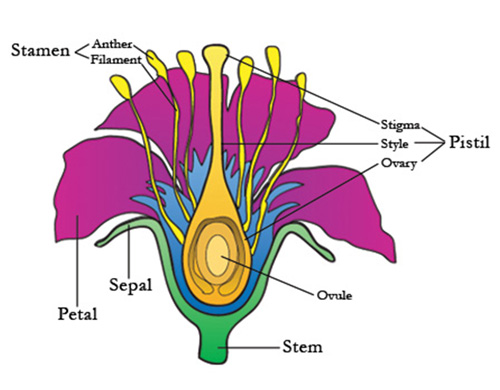 The male parts are called the Stamen and the female parts are called the Pistil or Carpel. The stigma is often moist and sticky and when a pollinator visits or if carried by wind and rain, pollen from other flowers land on it and travel down the tube (style) in the ovaries. Seeds develop and new flower life begins anew to be planted for new flowers.
 At the tip of this fragrant lavender stalk is an arrangement of dozens of little flowers. Pollinators, like this bumble bee inspects each of these tiny blossoms in search of food. Lavender and bumble bees are also common in North America. I photographed this pair in Rennes, France.
 I don't know the name of this flower - looks like a forb - or species of fly visiting this tall wild flower I found in an open-field in Groningen, the Netherlands. Notice the white-spiky parts, these are the reproductive parts of the plant, but I'm not exactly sure if it's the stamen or the pistil, I'm guessing stamen because of the volume.
 Despite the strong winds, the flies (there are 2 in this photo) were able to hold on tight and continue foraging. You'll also notice that many of the flower buds have yet to open up on this pink flower.
 A tiny little grass flower, very dainty with a small tender fly on the petal. If you look closely, the tiny knobs in a circle are the stamen. Photo taken in Groningen, the Netherlands.
 This Echinacea flower has a spiny head referred to as a cone, which is where it gets its common name the purple cone flower.. The stamen and pistil aren't very distinct, but the flower still attracts many kinds of pollinators with its height and colorful petals.
 A fly visiting the flower. Not sure of the fly species but there are similar - bee-looking flies in North America that also visit cone flowers, daisies, and sunflowers. I photographed these flowers in Niennord Park in Leek, the Netherlands.
 I was surprised to see this large bumble bee climbing along the stalk of the flower. That is not typical behavior at all. I wanted a closer look at this bee because I noticed it had a white rump. I had never seen a white-rumped bumble bee in the States before. When I returned to school, I asked my lab mate and bumble bee expert, Javier Hernandez to identify it for me. It is Psithyrus or cuckoo bumble bee. It gets this name because, like the cuckoo bird, the female lays her eggs in the nest of another species and let's that female take care of her pupae (babies).
 September Celebrates Biodiversity and Conservation